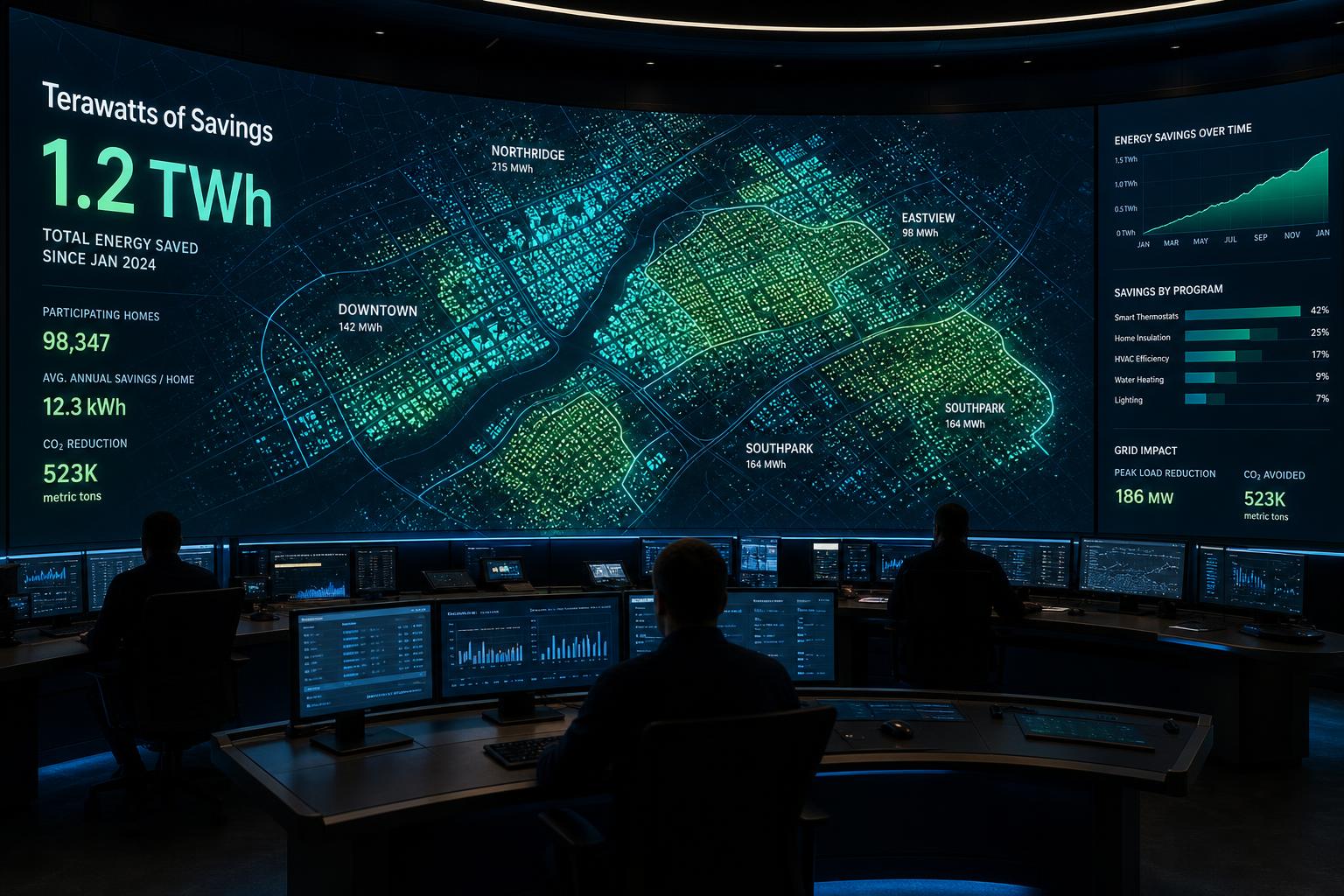
Design retrofit programs that actually get delivered.
HomeIQ analyzes an entire housing stock to determine how many homes qualify for heat pumps and other upgrades, which properties to target, what rebates to offer, what budget is required and what the program can achieve.
Lightspark Score
Energy Use
Carbon Emissions
Lightspark Score
Energy Use
Carbon Emissions
Annual Cost
$2,653
10-Year Cost
$26,533
Modeled Bill Load
100%Annual Cost
$1,064
10-Year Cost
$10,640
Modeled Bill Load
40%Budget is rarely the constraint.
The constraint is a delivery chain built from many vendors, a dozen disconnected tools, and 33 steps between awareness and a completed retrofit. Lightspark's Rapid Program Design replaces the guesswork with modelled offerings — and one system to deliver them.
Typical Energy Efficiency Programs are built like a maze
Oftentimes, a utility rebate program routes homes through at least 7 of 9 disconnected phases — awareness, eligibility, product ID, contractor sourcing, pre-audit, install, reporting, application, and payout. Each phase is often a different team, tool, or organization.
steps end to end
active hours required
months elapsed
cumulative abandonment
The bottleneck isn't installation. It's every disconnected step that happens before a contractor ever shows up.
A typical program runs on six separate vendors
Program design, marketing, implementation, evaluation, rebate processing, and financing are each typically procured, contracted, and run as separate systems — often by separate companies.
Program Design & Consulting
Portfolio strategy, goal-setting
Marketing & Outreach
Customer acquisition, campaigns
Implementation Contractor
Audits, installs, field delivery
EM&V (Evaluation)
Independent savings verification
Rebate & Incentive Processing
Applications, QA/QC, payment
Trade Ally & Financing Network
Contractor network, loan products
30–40% of budget → outsourced, disconnected delivery
Source: E Source research on outsourced energy-efficiency spending, cited in NRECA/TechSurveillance Directory of Energy Efficiency Implementation Contractors.
The tools don't talk to each other, either
It's not just that utilities juggle six vendors. Each vendor juggles its own patchwork of point solutions just to deliver the work — an audit tool, a separate reporting platform, a separate rebate tracker.
The same data, entered two or three times
When one of the industry's own audit-software vendors announced an integration with a separate reporting platform, they described the problem plainly: contractors nationwide often have to enter the same audit data two or three times to satisfy different program and reporting systems.
— Snugg Home, on its EnergySavvy reporting integration
Point solutions, bolted together by acquisition
Even large implementation contractors don't build one platform — they acquire separate point tools and stitch them together. Franklin Energy, one of the industry's largest implementation contractors, acquired audit-software vendor Snugg Home in 2024 specifically to fill a gap in its own delivery stack.
— Franklin Energy / Snugg Pro, company history
Fragmentation isn't just a market structure problem. It's baked into how individual programs get delivered day to day — by design, not by accident.
What it actually costs to run an efficiency program
Independent research on hundreds of U.S. utility programs shows where the money already goes — before adding a single new vendor.
average levelized cost for program administrators to save a kilowatt-hour, across 2,100+ program-years of data
average utility spending per customer on efficiency incentives nationally — ranging from $0 to $128 depending on the state
the total cost of a saved kilowatt-hour once participant contributions are counted — roughly double the program-administrator-only figure
None of this is the measures' fault. It's the cost of coordinating delivery across a fragmented vendor stack — the part Engage actually fixes.
Sources: Lawrence Berkeley National Laboratory, Cost of Saving Electricity through Energy Efficiency Programs Funded by Utility Customers (2009–2018 data) and The Total Cost of Saving Electricity (participant + administrator costs); U.S. Energy Information Administration, EIA-861 survey (2016).
What Rapid Program Design does for a Retrofit Program
- Turns an address into a modelled home in minutes, with no truck roll
- Converts model output into ranked, costed, rebate-netted bundles
- Routes committed homeowners to vetted trades
- Captures every step as structured program data
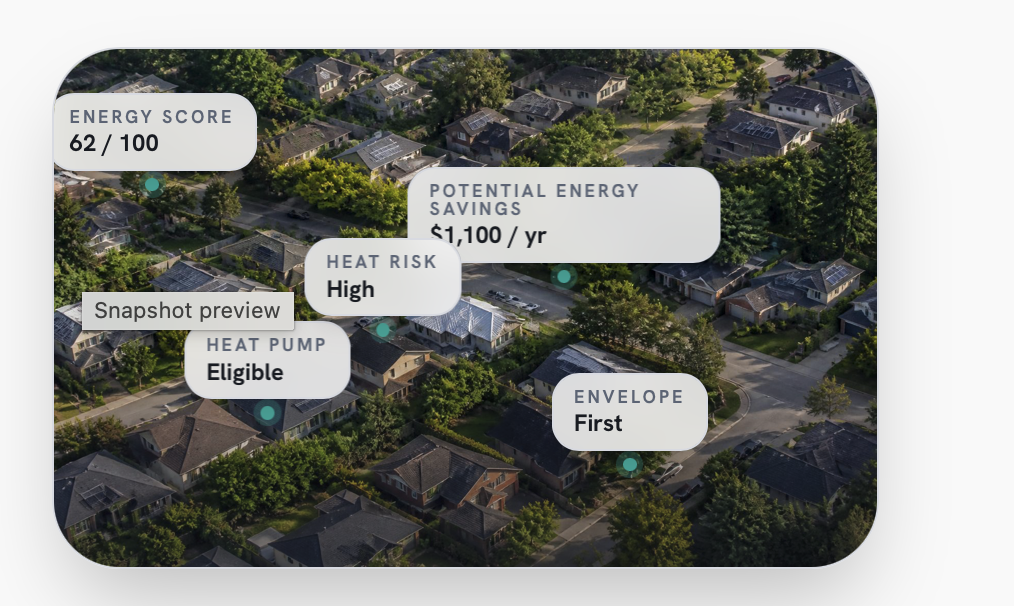
Design an offering, see the outcome
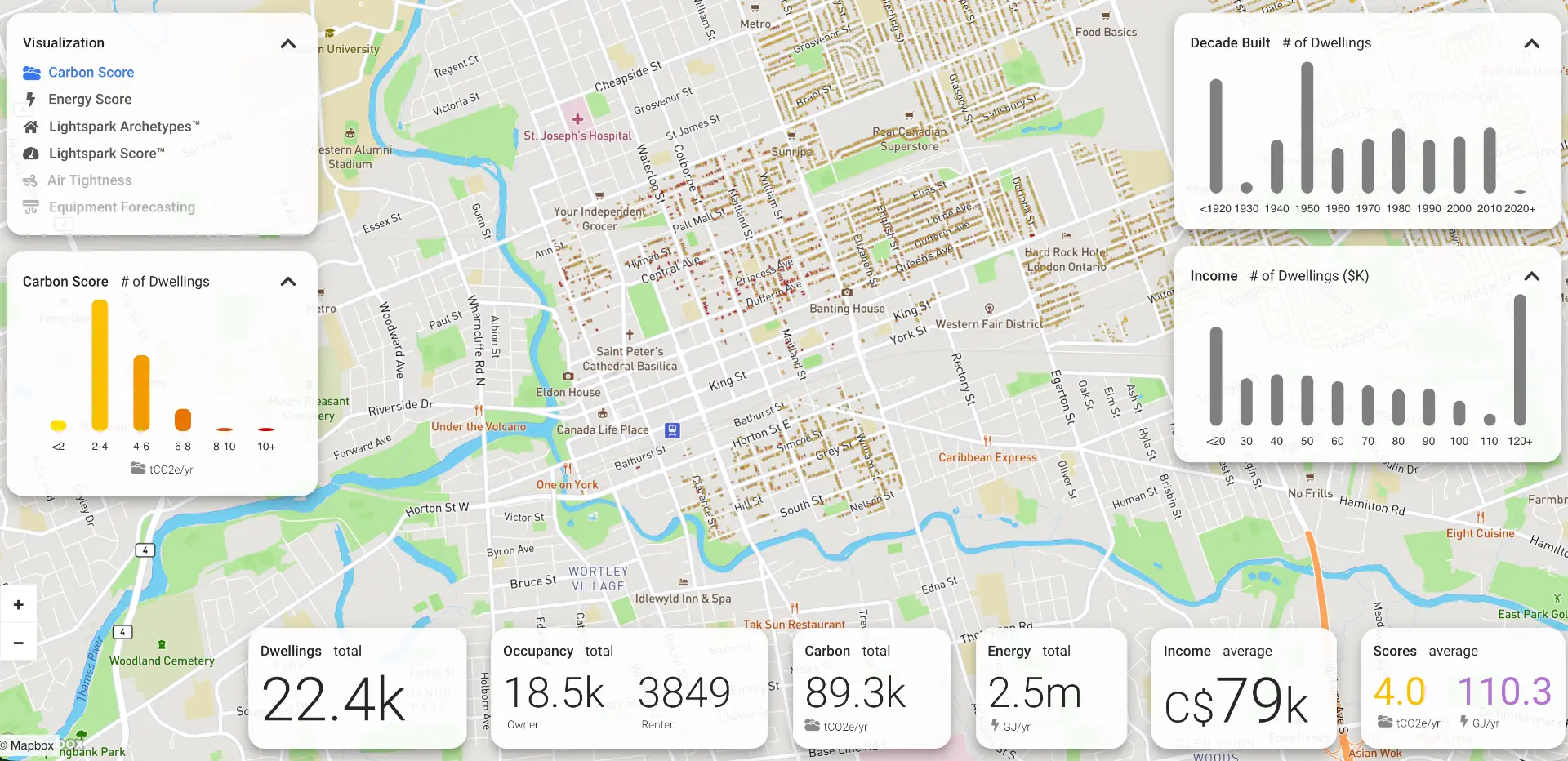
HomeIQ's Rapid Program Design builds each income-banded offering in HomeIQ: upgrade bundles by dwelling type, existing versus proposed rebate, budget split — and the carbon, energy and cost outcomes recalculated as you tune it. Then when you've analyzed the program design, we configure Engage to the design, and we have a digital concierge for the delivery of the program to homeowners.

London, Ontario
Carbon score overlay · 18,420 dwellings analyzed
From housing stock to a program you can deliver
- 01
Analyze the housing stock
- 02
Identify qualifying homes
- 03
Model upgrade bundles
- 04
Set rebates and budget
- 05
Project program impact
Meet Engage: one system, seven minutes
Digital Home Survey
Guided questions about heating, envelope, and comfort — no paperwork, no site visit to start.
Instant Score Dashboard
Energy, carbon, and comfort scores benchmarked against 5M+ North American homes, with a clear savings estimate.
Personalized Recommendations
Upgrades ranked by cost, rebate value, and 10-year savings — tailored to the property.
Trade Network Match
Homeowners connect directly with qualified local contractors to move straight into installation.
“If we are really going to scale energy retrofits across North America, we need to use machine learning and AI to identify highest energy and carbon using buildings, develop retrofit programs, and support homeowners in making wise decisions. I've joined Lightspark as an advisor because their technology is best in class and can play a critical role in helping cities, utilities, homeowners, and others to reduce energy and carbon emissions in our existing buildings. We need to massively scale-up retrofits and use cutting-edge approaches – Lightspark will be key in doing that.”

Sadhu Johnston
former City Manager and Deputy City Manager, City of Vancouver; former Chief Environmental Officer, City of Chicago